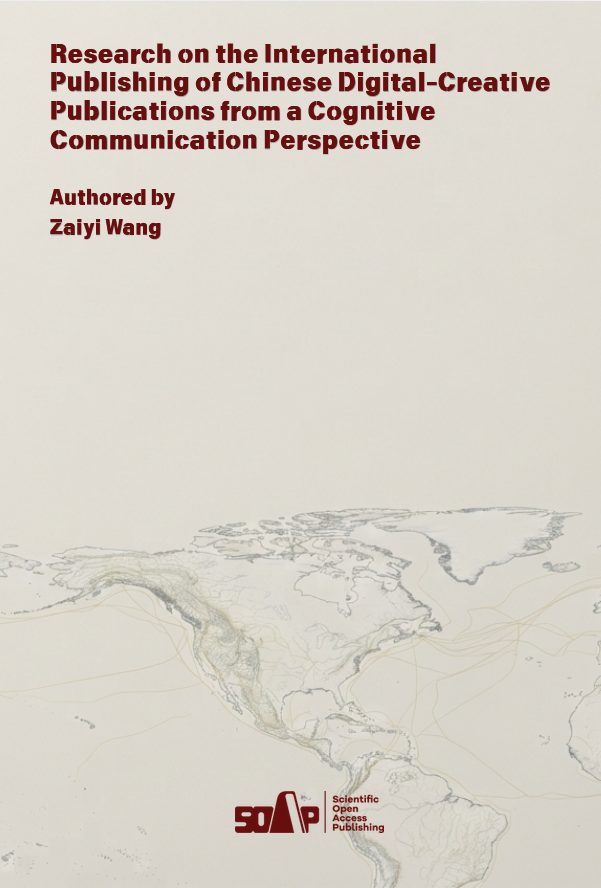
Research on the International Publishing of Chinese Digital-Creative Publications from a Cognitive Communication Perspective
Detailed Information
Author Introduction
Book Introduction
Catalog
This book, grounded in the contemporary context of generative artificial intelligence profoundly reshaping the global content publishing industry, creatively introduces the overarching theoretical perspective of “cognitive communication” to systematically study the international publishing of Chinese digital creative publications. Breaking away from the outdated paradigm of traditional Chinese publishing—”one-way output, translation and transplantation, and channel expansion”—it constructs a three-dimensional analytical framework of “cognition—discourse—institution” and a four-dimensional new paradigm of international communication—”intelligent production—cross-domain adaptation—layered dissemination—institutional hierarchy”—around the core proposition of “from information arrival to cognitive construction, from content going global to rule presence”. The book unfolds in seven chapters: the introduction defines the cognitive shift in the era of intelligent media and the international propositions of Chinese digital creative publishing; Chapter Two clarifies core concepts and lays the foundation for interdisciplinary theory; Chapter Three empirically examines the current state of development and deep-seated dilemmas; Chapter Four deconstructs the cognitive drawbacks of traditional paradigms and the disruptive changes of AIGC; Chapter Five originalally constructs a new paradigm and a differentiated cognitive adaptation model based on hierarchical classification; Chapter Six proposes a systematic practical path guided by cognitive communication; and Chapter Seven presents conclusions, limitations, and a future vision. This book combines theoretical originality, interdisciplinary nature, and industry foresight, filling a systematic gap in the research on the integration of cognitive communication, digital creative publishing, and the international dissemination of Chinese culture. It can provide theoretical support and practical reference for the high-quality internationalization of Chinese digital publishing in the intelligent era, the upgrading of the global narrative of Chinese culture, and the enhancement of international cultural discourse power.
China’s “going global” publishing strategy has long been measured by copyright export and translation volume, yet it struggles to secure a rule seat within the global knowledge infrastructure constituted by algorithmic ranking, index evaluation and training corpora. Adopting cognitive communication as a governing perspective, this book investigates how digital creative publications are cognized by overseas audiences, discursively constructed across cultures, and institutionally adopted in international publishing. It argues that while generative AI magnifies reach, it also embeds Chinese publishing more deeply into an external power order, highlighting the tension of “rising output but unchanged positional standing”. The book accomplishes three theoretical tasks: it builds a triadic analytical framework of “cognition–discourse–institution”, proposes an original four-dimensional paradigm of “intelligent production–cross-domain adaptation–stratified circulation–institutional positioning” together with its differentiated cognitive-adaptation model, and demonstrates the leap from communication efficiency to institutional discourse power,encompassing the autonomous development of regional corpus‑based knowledge bases, the coordinated triad of publishing–media–think tanks, the establishment of AI‑driven publishing standards and copyright frameworks, and the de‑monopolization of academic evaluation. By doing so, the study offers a systematic framework and actionable governance schemes for the international communication of Chinese digital creative publishing in the intelligent era, achieving interdisciplinary innovation at the intersections of cognitive communication, publishing studies, and cross-cultural geopolitical communication.
This book would not have been completed without the support of Professor Wu Fei from the School of Journalism and Communication, Jinan University, to whom I wish to express my sincere gratitude first and foremost.His profound scholarship in international communication and geopolitical awareness communication provided fundamental guidance for this book. I would also like to thank my colleagues at Jinan University and the relevant academic platforms and research groups for their support and inspiration in data accumulation, case studies, and academic discussions. Furthermore, I thank the publishing professionals, editors, and overseas collaborators who participated in the interviews and research; their practical insights enabled the book to maintain a dialogue between theory and industry. Finally, I thank my family, especially my wife, for their long-standing understanding and companionship. The author assumes full responsibility for any omissions or errors in the book.
The main findings are as follows:
(1) Since 2004, permafrost in the Xiao Xing’an Mountains has undergone significant degradation, characterized by a continuous rise of the lower permafrost boundary and a gradual lowering of the upper boundary, with the upward migration of the lower boundary being more pronounced, indicating progressive structural instability.
(2) Tropospheric CH₄ concentrations in Northeast China exhibit significant seasonal variability, with the highest growth rate in spring (6.120 ppbv·a⁻¹ at 600 hPa), followed by autumn and winter (5.830 and 5.470 ppbv·a⁻¹, respectively), and the lowest in summer (4.030 ppbv·a⁻¹). Degrading permafrost regions represent an important methane source, including microbial production, wetland transport, and geological methane stored in frozen layers (metastable and stable methane hydrates, as well as deep thermogenic gas).
(3) Methane emissions in the study area exhibit a distinct three-stage pattern: a short-duration high-intensity release in spring (March–May, ~5 days, surface concentrations exceeding 1000 ppm); a long-duration stable release in summer (June–August, >2 months, up to ~453 ppm); and a short episodic release in autumn (September–November, ~3 days cycle, up to ~326 ppm).
(4) In addition to lightning and anthropogenic ignition sources, atypical wildfires occur in permafrost swamp regions during spring. These fires are predominantly observed in low-temperature, high-humidity lowland areas, showing a significant correlation with methane emissions (maximum correlation coefficient up to 0.7). Methane release and associated near-surface charge accumulation enhance static electricity buildup, facilitating ignition of combustible gases and vegetation residues. Under high methane concentrations, lightning or anthropogenic sparks more readily trigger combustion. Moreover, methane–aerosol interactions (dust, sea salt, sulfate, and black carbon) enhance radiative forcing, further intensifying regional warming and fire susceptibility.
(5) With continued permafrost degradation, subsurface methane and water migrate upward, forming localized high pore-pressure zones, exhibiting a “confined gas pressure accumulation effect.” Increased pore pressure and changes in permeability reduce effective stress, frictional strength, and cohesion, leading to structural failure and triggering landslides, differential settlement, and localized uplift. Results indicate that when the water–gas reduction coefficient decreases from 1.0 to 0.72, the slope stability factor reduces from 1.16 to 0.94; when methane pressure increases from 0.11 to 2.14, the failure influence radius increases from 1.62 to 2.52.