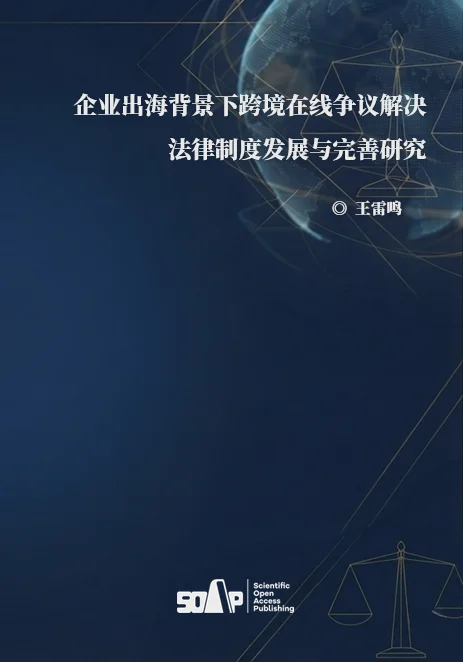
企业出海背景下跨境在线争议解决法律制度发展与完善研究
Authored byLWLeiming Wang Leiming WangAuthor Wang Leiming, Ph.D., is an Associate Professor whose research primarily focuses on international legal governance mechanisms, cross-border dispute resolution and compliance, Legal… Full introduction below
Wang Leiming, Ph.D., is an Associate Professor whose research primarily focuses on international legal governance mechanisms, cross-border dispute resolution and compliance, Legal English, philosophical theory, and intercultural studies. He possesses a robust interdisciplinary background spanning Law, Finance, and Linguistics. Dr. Wang holds several prestigious professional qualifications, including membership in the Chartered Institute of Arbitrators (CIArb), and certifications as a U.S. Certified Forensic Accountant (CRFA), a Senior Corporate Compliance Officer, and a Senior Translator. He serves as an editorial board member and peer reviewer for various domestic and international academic journals, such as the Global Social Science Review and Dispute Resolution. Throughout his career, Dr. Wang has led or participated in eight research projects at the national, provincial, and ministerial levels. He has authored eight academic monographs and co-authored one provincial-level planned textbook. His scholarly output includes over 40 papers published in prestigious core-indexed journals, including SSCI (Q1), SCI, CSSCI, A&HCI, and EI. A frequent keynote speaker at international academic conferences, he is a member of the Law Society of England and Wales, the China Law Society, and the IEEE. Dr. Wang bridges the gap between theory and practice with extensive experience in both corporate environments and higher education research.
The globalization of the digital economy and the deep expansion of Chinese enterprises into international markets have catalyzed a surge in cross-border commercial disputes characterized by small claims, high frequency, and cross-domain virtualization. Traditional dispute resolution systems, centered on litigation and institutional arbitration, are increasingly ill-equipped to meet the governance needs of the digital age due to structural flaws such as procedural rigidity, high costs, lengthy cycles, and jurisdictional conflicts. As a product of the deep integration of digital technology and Alternative Dispute Resolution (ADR) mechanisms, Cross-border Online Dispute Resolution (ODR) has emerged as the core pathway to resolving these governance dilemmas and achieving "digital justice." Set against the backdrop of the legal needs of Chinese enterprises "going global," this book systematically constructs a framework for perfecting the legal system of cross-border ODR by synthesizing legal dogmatics, comparative research, interdisciplinary analysis, and empirical methods.
From a substantive law dimension, the study focuses on six core areas—legal standing, electronic contracts, electronic evidence, choice of law, liability, and intellectual property protection—to analyze current systemic challenges, including rule fragmentation, insufficient international alignment, and a lack of technological adaptability. By drawing on the experiences of the EU, the U.S., and UNCITRAL, the book proposes a systematic set of substantive rules. Simultaneously, regarding the procedural law dimension, the research is guided by theories of procedural justice and digital governance to systematically refine the three core procedures of cross-border ODR—online mediation, online arbitration, and online litigation—while further constructing supporting mechanisms for procedural linkage, interim measures, and enforcement guarantees to overcome practical obstacles such as procedural barriers, data compliance, and cross-border enforcement. Ultimately, the book argues that China should establish a localized institutional foundation while leveraging international rule coordination to promote a cross-border ODR legal system that is fair, efficient, compatible, and comprehensive, thereby providing a solid legal safeguard for Chinese enterprises expanding globally and contributing a "Chinese Solution" to global digital dispute governance.
This book is the final research output of the General Project of Fujian Provincial Social Science Fund, titled "Research on the Development and Improvement of the Legal System for Cross-Border Online Dispute Resolution in the Context of Enterprises Going Global" (Grant No. FJ2026B038). Sincere gratitude is extended to the Fujian Provincial Philosophy and Social Sciences Planning Office and all supporting parties for their generous sponsorship and assistance.



Step into the birthplace of words, and feel the warmth of craftsmanship and history.