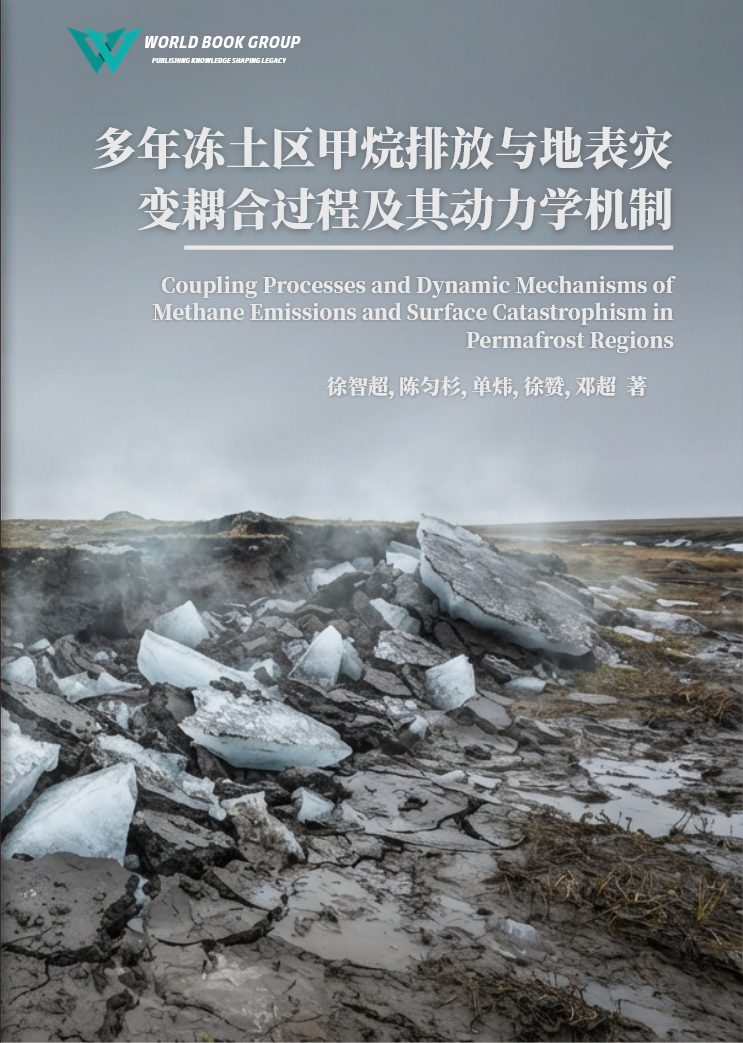
Coupling Processes and Dynamic Mechanisms of Methane Emissions and Surface Catastrophism in Permafrost Regions多年冻土区甲烷排放与地表灾变耦合过程及其动力学机制
Detailed Information
Author Introduction
Book Introduction
Catalog
Xu Zhichao (Male, born 1992, from Qingdao, Shandong) holds a Ph.D. in Engineering and is a member of the Jiusan Society, a master’s supervisor, and a senior technology manager. His research focuses on the mechanisms of freeze-thaw disasters in cold-region soils, multi-field coupled numerical simulation, and the prevention and control of geological environmental hazards. He places particular emphasis on methane release behavior during permafrost degradation and the coupled response mechanisms between methane release and surface environmental systems; he has conducted systematic research specifically on near-surface energy perturbations driven by methane emissions, wildfire occurrence mechanisms, and the chain evolution of surface disasters. He has led or participated in over 30 projects—including those funded by the National Natural Science Foundation of China, the Hunan Provincial Natural Science Foundation (Youth Fund), and the Hunan Provincial Department of Education (Outstanding Youth Fund), as well as industry-sponsored technical development projects. His work centers on the evolution of the mechanical behavior of freeze-thaw soils and multi-physics coupling modeling methods, establishing a stable research direction and a solid foundation of achievements. He has published over 30 academic papers in the fields of freeze-thaw soil mechanics and multi-physics coupled simulation and holds more than 10 authorized national invention patents; some of his research findings have been applied in engineering consulting and scientific research practice.
Chen Yunshan (Female, born 1993, Han ethnicity, from Shuangyashan, Heilongjiang) is an engineer holding a Master’s degree in Engineering. Her research focuses on geological environmental processes in cold regions and multi-source data analysis, with a solid foundation in identifying surface changes in permafrost regions, remote sensing retrieval of methane emissions, and extracting geoscientific information. She conducts research on methane emission processes in permafrost regions and their response mechanisms regarding surface disasters, participating in the analysis of spatiotemporal methane distribution, the identification of environmental factors triggering wildfires, and data processing for surface deformation responses; she has accumulated significant experience in multi-source remote sensing data fusion and the extraction of surface change processes. She has presided over multiple projects, including general projects funded by the Hunan Provincial Department of Education, special projects in social sciences for Yiyang City, and university-level educational reform projects; she has also participated in numerous provincial, ministerial, and municipal-level research projects and supervised a provincial-level innovation and entrepreneurship project for university students. She has published over 10 academic papers and holds more than 10 patents (either accepted or authorized). Participating teams have won the Third Prize for Excellent Urban and Rural Planning and Design in Heilongjiang Province, as well as the Second Prize in the Digital Teaching Competition and the Third Prize in the “Curriculum Ideological and Political Education” Teaching Competition for universities in Hunan Province. Individually, the recipient won the Third Prize in the Teacher Teaching Innovation Competition at Hunan City University and has guided students to win multiple awards in national and provincial academic competitions.
Shan Wei (Male, born 1965, CPC member, Ph.D. in Engineering, Professor, Doctoral Supervisor) is an expert receiving the State Council Special Allowance, a “Grassland Talent” of the Inner Mongolia Autonomous Region, and one of the first senior experts in China’s forestry engineering construction sector. He currently serves as the Dean of the Institute of Cold Region Science and Engineering at Northeast Forestry University, the academic leader for the discipline of Cold Region Transportation Disaster Prevention and Mitigation Engineering, and the Director of the Ministry of Education’s Field Scientific Observation and Research Station for Geological Environment Systems in Permafrost Regions. He has long been engaged in research on cold region engineering geology and permafrost disaster prevention and control, possessing a systematic research foundation in areas such as permafrost degradation mechanisms, engineering responses, geological methane release, and wildfire-induced disasters. He has published over 100 papers (including 65 indexed in SCI and 55 in EI) and authored four books. He has presided over research projects funded by the National Natural Science Foundation of China, the Ministry of Transport, and various provincial, ministerial, and international cooperation programs. He has received numerous awards, including the Achievement Award from the International Landslide Research Project, the Second Prize for Scientific and Technological Progress in Heilongjiang Province, and the Second Prize for Excellent Engineering Design from the Ministry of Education.
Xu Zan (Male, Ph.D. candidate, Lecturer) is a council member of the Hunan Society for Rock Mechanics and Engineering, an expert reviewer for construction projects in Hunan Province, and a reviewer for SCI journals such as the *International Journal for Numerical and Analytical Methods in Geomechanics*, *Scientific Reports*, *Water*, *Discover Applied Sciences*, and *Advances in Civil Engineering*. His research primarily focuses on soil mechanics and engineering, shield tunneling, and multi-field coupled numerical simulation for underground engineering, with a specific emphasis on the coupling mechanisms between underground engineering structures and the geological environment, as well as the processes of disaster-induced responses. He has participated in two projects funded by the National Natural Science Foundation of China, presided over five provincial and ministerial-level research projects (including those funded by the Hunan Federation of Social Science Circles and the Ministry of Education’s “Employment-Education Integration” program), led four projects funded by the Hunan Provincial Department of Education and the Yiyang Municipal Natural Science Foundation, and authored one textbook. He has published over 20 academic papers in the fields of soil mechanics, geotechnical engineering, and underground engineering, with more than 10 indexed by SCI or EI. He holds 6 authorized Chinese invention patents, 9 international invention patents, 12 utility model patents, and 11 software copyrights.
Deng Chao (male, born in 1989, from Suizhou, Hubei Province) holds a Ph.D. in Engineering, is a member of the Communist Party of China, a master’s supervisor, and a certified highway and waterway testing engineer. He heads the Grouting Engineering Technology Research Center at Hunan City University. His work focuses on the development and utilization of green, low-carbon cementitious materials and research into the multi-field coupling theory and technology of grouting engineering. He places particular emphasis on the evolution of stratum structure during grouting and the mechanisms by which it affects the groundwater environment and surface deformation; his work also intersects with research on geological disaster processes in permafrost regions. He has presided over or participated in more than 20 research projects (both government-funded and industry-sponsored), including those supported by the National Natural Science Foundation of China, the Hunan Provincial Natural Science Foundation, and the Hunan Provincial Department of Education. He has established a systematic research foundation regarding the mechanisms of heave deformation in sandy soil grouting, the synergistic effects between the solidification of multi-component grouting materials and the environment, and the multi-field coupling theory of grouting. He has published over 30 papers in domestic and international journals, including publications in key academic journals (C-list journals) as the first or corresponding author.
The Earth’s cryosphere represents one of the most climate-sensitive and important global carbon reservoirs. Its carbon storage exists not only in the form of organic carbon within permafrost soils, but also as methane and other gases trapped in permafrost layers, underlying sediments, and frozen media. Climate change continues to threaten the stability of this vast carbon pool. The cryosphere is currently retreating at an average rate of approximately 8.7 × 10⁴ km²·a⁻¹, and nearly 80% of boreal forests are located within permafrost-affected regions. Over the past two decades, boreal forest fires have annually affected more than 1% of forested areas, with a continuously increasing frequency. Meanwhile, permafrost degradation has significantly intensified along the southern margin of the Eurasian permafrost zone, particularly in southeastern Siberia and Northeast China. This has triggered a range of geomorphological and geohazard processes, including landslides, debris flows, thermokarst subsidence, and thermokarst lake formation. Redistribution of pore pressure induced by permafrost meltwater migration and the release of stored gases is considered a key internal mechanism driving these enhanced surface responses. Among these gases, methane plays a dominant role, and its generation, migration, and release are critical processes governing permafrost system evolution. To address these scientific issues, a representative study area was selected in the permafrost swamp zone along the K153–K183 section of the Bei’an–Heihe Expressway at the margin of the Sunwu–Jiayin Basin in the northern Xiao Xing’an Mountains, Northeast China (127°17′31″–127°21′24″E, 49°30′57″–49°41′50″N). A comprehensive investigation was conducted focusing on permafrost degradation, methane emissions, and associated environmental effects.
In terms of observations and data acquisition, a multi-parameter monitoring system was deployed, including methane concentration sensors, atmospheric temperature sensors, pore water pressure sensors, atmospheric electric field instruments, and soil temperature sensors, enabling long-term continuous measurements. Integrated geophysical and remote sensing techniques, including high-density resistivity (HDR), ground-penetrating radar (GPR), field drilling, and MODIS data, were used to characterize permafrost distribution and degradation patterns. Sentinel-2 (L1C) imagery, UAV-based observations, and 3D reconstruction techniques were further employed to quantify surface deformation and landscape evolution. For atmospheric processes, AIRS (Aqua satellite) data were used to reconstruct the spatiotemporal distribution of tropospheric methane over Northeast China. A porous-media gas transport model was developed to simulate methane migration and diffusion under permafrost degradation conditions. Regarding fire response mechanisms, Landsat TM and Sentinel-2 data were used to analyze the spatial correlation between methane emissions and wildfires. Laboratory gas–solid frictional electrification experiments were conducted to verify charge generation induced by particle interactions, combined with in situ atmospheric electric field measurements to reveal potential seasonal wildfire triggering pathways. For surface deformation analysis, field monitoring data of landslides and subsidence were combined with laboratory triaxial shear tests and high-pressure methane exposure experiments (including methane hydrate dissociation processes) to systematically investigate deformation mechanisms induced by permafrost degradation. In terms of theoretical modeling, based on the strength reduction method, a fully coupled thermo–hydro–mechanical–chemical (THMC) framework considering methane effects was established. Incorporating methane hydrate dissociation kinetics, a failure model of overburden instability driven by meltwater–gas migration in permafrost degradation zones was developed, followed by numerical simulations.
The main findings are as follows:
(1) Since 2004, permafrost in the Xiao Xing’an Mountains has undergone significant degradation, characterized by a continuous rise of the lower permafrost boundary and a gradual lowering of the upper boundary, with the upward migration of the lower boundary being more pronounced, indicating progressive structural instability.
(2) Tropospheric CH₄ concentrations in Northeast China exhibit significant seasonal variability, with the highest growth rate in spring (6.120 ppbv·a⁻¹ at 600 hPa), followed by autumn and winter (5.830 and 5.470 ppbv·a⁻¹, respectively), and the lowest in summer (4.030 ppbv·a⁻¹). Degrading permafrost regions represent an important methane source, including microbial production, wetland transport, and geological methane stored in frozen layers (metastable and stable methane hydrates, as well as deep thermogenic gas).
(3) Methane emissions in the study area exhibit a distinct three-stage pattern: a short-duration high-intensity release in spring (March–May, ~5 days, surface concentrations exceeding 1000 ppm); a long-duration stable release in summer (June–August, >2 months, up to ~453 ppm); and a short episodic release in autumn (September–November, ~3 days cycle, up to ~326 ppm).
(4) In addition to lightning and anthropogenic ignition sources, atypical wildfires occur in permafrost swamp regions during spring. These fires are predominantly observed in low-temperature, high-humidity lowland areas, showing a significant correlation with methane emissions (maximum correlation coefficient up to 0.7). Methane release and associated near-surface charge accumulation enhance static electricity buildup, facilitating ignition of combustible gases and vegetation residues. Under high methane concentrations, lightning or anthropogenic sparks more readily trigger combustion. Moreover, methane–aerosol interactions (dust, sea salt, sulfate, and black carbon) enhance radiative forcing, further intensifying regional warming and fire susceptibility.
(5) With continued permafrost degradation, subsurface methane and water migrate upward, forming localized high pore-pressure zones, exhibiting a “confined gas pressure accumulation effect.” Increased pore pressure and changes in permeability reduce effective stress, frictional strength, and cohesion, leading to structural failure and triggering landslides, differential settlement, and localized uplift. Results indicate that when the water–gas reduction coefficient decreases from 1.0 to 0.72, the slope stability factor reduces from 1.16 to 0.94; when methane pressure increases from 0.11 to 2.14, the failure influence radius increases from 1.62 to 2.52.