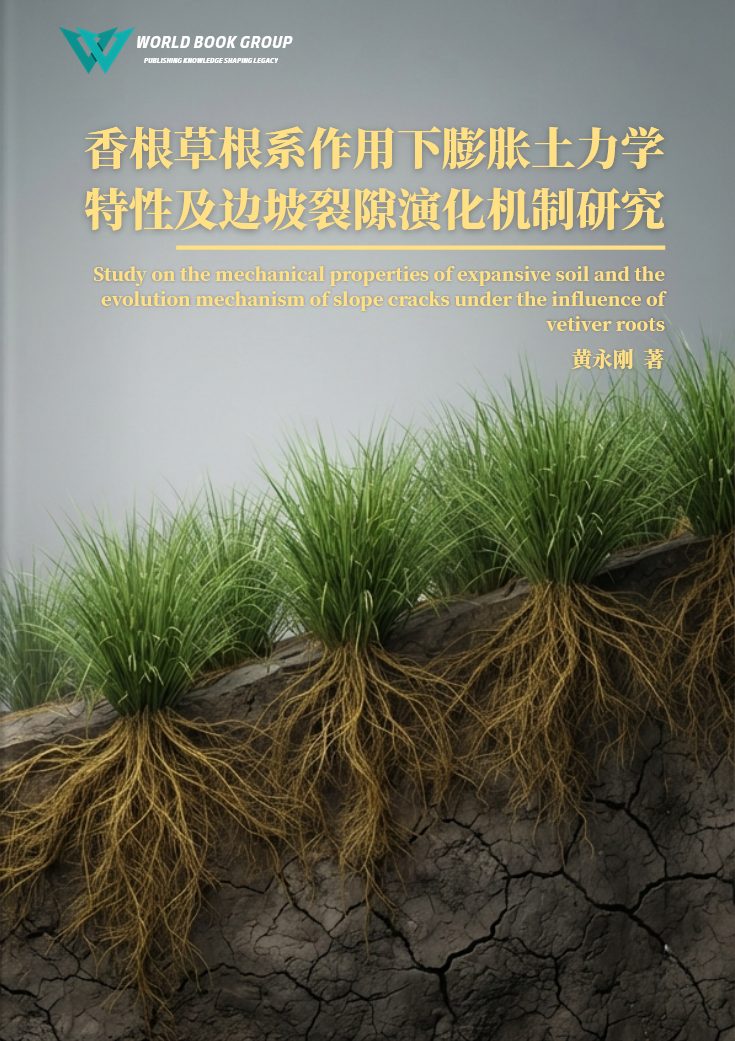
Study on the mechanical properties of expansive soil and the evolution mechanism of slope cracks under the influence of vetiver roots香根草根系作用下膨胀土力学特性及边坡裂隙演化机制研究
Detailed Information
Author Introduction
Book Introduction
Catalog
Yonggang Huang(male, born in 1990) holds a Ph.D. in Engineering, specializing in Civil Engineering. He is a lecturer and a master’s supervisor, currently serving on the faculty of the School of Civil Engineering at Hunan City University. His research focuses primarily on the fields of geotechnical engineering and environmental geotechnics.
The issue of expansive soil slopes has long been a representative and complex challenge in the field of geotechnical engineering. Expansive soils swell upon wetting and shrink upon drying; their strength, structure, and permeability are highly sensitive to fluctuations in moisture content. In natural environments, the interplay of rainfall infiltration, evaporative water loss, and seasonal wet-dry cycles subjects slope soils to continuous cycles of swelling and shrinkage, crack initiation and propagation, and structural degradation. These processes can trigger engineering hazards such as shallow slumping, surface erosion, and a decline in overall slope stability. Particularly against the backdrop of frequent extreme rainfall events and the ongoing advancement of ecological civilization, achieving long-term stability, safe service, and ecological restoration for expansive soil slopes has become a critical topic of shared interest in both engineering practice and theoretical research.
Traditional remediation methods for expansive soil slopes primarily rely on engineering measures such as slope trimming, soil replacement, drainage, retaining structures, and rigid support systems. While these methods can improve slope stability under certain conditions, they often entail high costs, poor ecological compatibility, and limited long-term adaptability. In contrast, vegetation-based slope protection offers multiple benefits—including soil stabilization, erosion control, moisture regulation, and ecological improvement—and has increasingly become a key direction for the protection of expansive soil slopes. Vetiver grass, in particular, shows great promise for the ecological remediation of slopes composed of special soils, thanks to its extensive root system, strong stress resilience, and exceptional soil-penetrating and stabilizing capabilities. However, the role of root systems extends beyond simple soil reinforcement; their influence on soil strength, swelling-shrinkage behavior, soil-water characteristics, and crack evolution involves complex, multi-factor coupling. How do root systems alter soil structure? How do they inhibit the propagation of desiccation cracks? How do they generate synergistic protective effects when combined with engineering reinforcements like geogrids? These questions require systematic investigation through experimental studies, theoretical modeling, and engineering simulations.
This book addresses precisely these issues. Centering on the vetiver grass ecological protection system and incorporating geogrid reinforcement, this book employs a comprehensive approach—combining laboratory tests, field planting trials, scaled model tests, and numerical simulations—to systematically analyze the mechanisms by which root-soil interactions influence the mechanical properties, swelling characteristics, soil-water behavior, and cracking evolution of expansive soils. The book focuses on the patterns of change in the strength and swelling-shrinkage deformation of expansive soil under varying root contents, revealing how vetiver root systems regulate the initiation, propagation, and coalescence of cracks during wetting-drying cycles. Building on this, the authors construct statistical models for crack development and models defining the relationships between influencing factors; integrating theories of unsaturated soil mechanics and fracture mechanics, they establish a model for predicting crack depth. Furthermore, the book elucidates the control mechanisms by which the synergistic reinforcement of roots and geogrids governs planar crack propagation, spatial crack development, and slope stability.
This book aims to bridge the gap between research into crack evolution mechanisms in expansive soil slopes and the practice of ecological protection engineering. It addresses both the degradation patterns of this unique soil type under rainfall-evaporation cycles and the theoretical underpinnings and technical pathways for synergistic reinforcement using ecological and engineering measures. It is hoped that this work will provide a theoretical basis and practical reference for the ecological management of expansive soil slopes, the optimization of reinforced protection designs, and the prevention and control of related geological hazards. Given the significant regional variability and environmental sensitivity of expansive soil slopes, the insights presented herein require further validation and refinement through continued engineering practice; the authors welcome constructive criticism and feedback from fellow experts and readers.