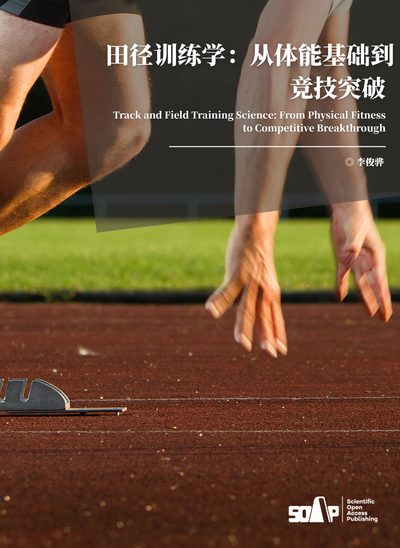
Track and Field Training Science: From Physical Fitness to Competitive Breakthrough
田径训练学:从体能基础到竞技突破
Detailed Information
Author Introduction
Book Introduction
Catalog

Reshaping the Foundation of Competition, Exploring the Path to Breakthroughs
Track and field, hailed as the “Mother of Sport,” is the competitive sublimation of humanity’s most instinctive running, jumping, and throwing movements, and the physical foundation of all modern sports. In the Olympic motto “Faster, Higher, Stronger—More United,” track and field undoubtedly provides the most direct and purest interpretation of this spirit. However, with the rapid development of modern competitive sports, the competitive landscape of world track and field is undergoing profound changes. As human physical capabilities gradually approach their physiological limits, every hundredth of a second improvement, every centimeter leap, is no longer merely a result of sweat, but a crystallization of wisdom from the cross-disciplinary integration of sports physiology, biomechanics, training science, and psychology.
Entering the period of Sino–Western integration, the introduction of modern anatomy, physiology, pathology, and empirical scientific methods during the late Qing and Republican eras broadened the perspective of constitution research. Western scholars developed theories relating body type, temperament, and mental health, while Chinese medical scientists attempted to correlate traditional constitution categories with biomedical indicators. Large-scale population studies in the mid-20th century gradually brought statistical and experimental approaches into body constitution analysis, marking a shift from experiential diagnosis to early scientific validation.
Looking back, my country’s track and field has achieved remarkable success through the hard work of generations. From early reliance on tenacious willpower and arduous training, to the practice of the “Three From One Big” principle, and now to the comprehensive embrace of scientific training, we have traversed a difficult path of transformation from empiricism to scientism. In this process, we have come to a profound realization: breakthroughs in competitive ability are by no means unearthed. They must be built upon a solid foundation of physical fitness, controlled by precise load management, and ultimately blossom through refined technical movements.
Currently, grassroots training still suffers from the misconception of “emphasizing technique while neglecting physical fitness” or “generalized physical training with insufficient specialization.” Many coaches and athletes, when facing competitive plateaus, often fall into the trap of blindly increasing training volume, neglecting to seek answers from the underlying logic—the scientific laws of human movement. Against this backdrop, the publication of *Track and Field Training: From Physical Fitness Foundation to Competitive Breakthrough* is particularly timely and substantial.
This book does not merely list traditional track and field training methods but presents a broad disciplinary perspective. The author astutely captures the core contradictions of modern track and field training, creatively constructing a complete closed-loop system from “basic theory” to “physical fitness construction” and then to “technical specifications.” In particular, the book’s precise analysis of the three major energy systems, its discussion of training adaptation for different ages and genders, and its in-depth decoding of the physiological mechanisms of core qualities such as strength, speed, and endurance all embody the modern training concept of “science-led training.”
Throughout the book, one finds both a high level of theoretical understanding, discussing the disciplinary positioning and development trends of track and field training science, and a deep practical application, detailing specific training methods from core strength to explosive power, and from aerobic endurance to specific endurance. This deep integration of theory and practice not only fills certain gaps in current track and field training textbooks regarding the “physical fitness-technique” transformation, but also provides an essential practical guide for frontline coaches, physical education teachers, and researchers.
A strong sports sector means a strong China; a prosperous nation’s sports sector is a prosperous nation. The scientific level of track and field directly reflects a country’s core competitiveness in competitive sports. It is hoped that the publication of this book will inject new scientific vitality into grassroots training in Chinese track and field, helping more athletes solidify their foundations on the scientific path and achieve breakthroughs on the competitive field.